 TurboGo
Benchmarks
Benchmark results and built-in features of TurboGo
TurboGo is a high-performance, modular Go web framework built for speed, simplicity, and extensibility.
⚠️ Benchmarked on Windows amd64, Ryzen 5 5600H, Go 1.24. The test was run 3 times consecutively, and the result displayed corresponds to the final iteration.
Average Latency
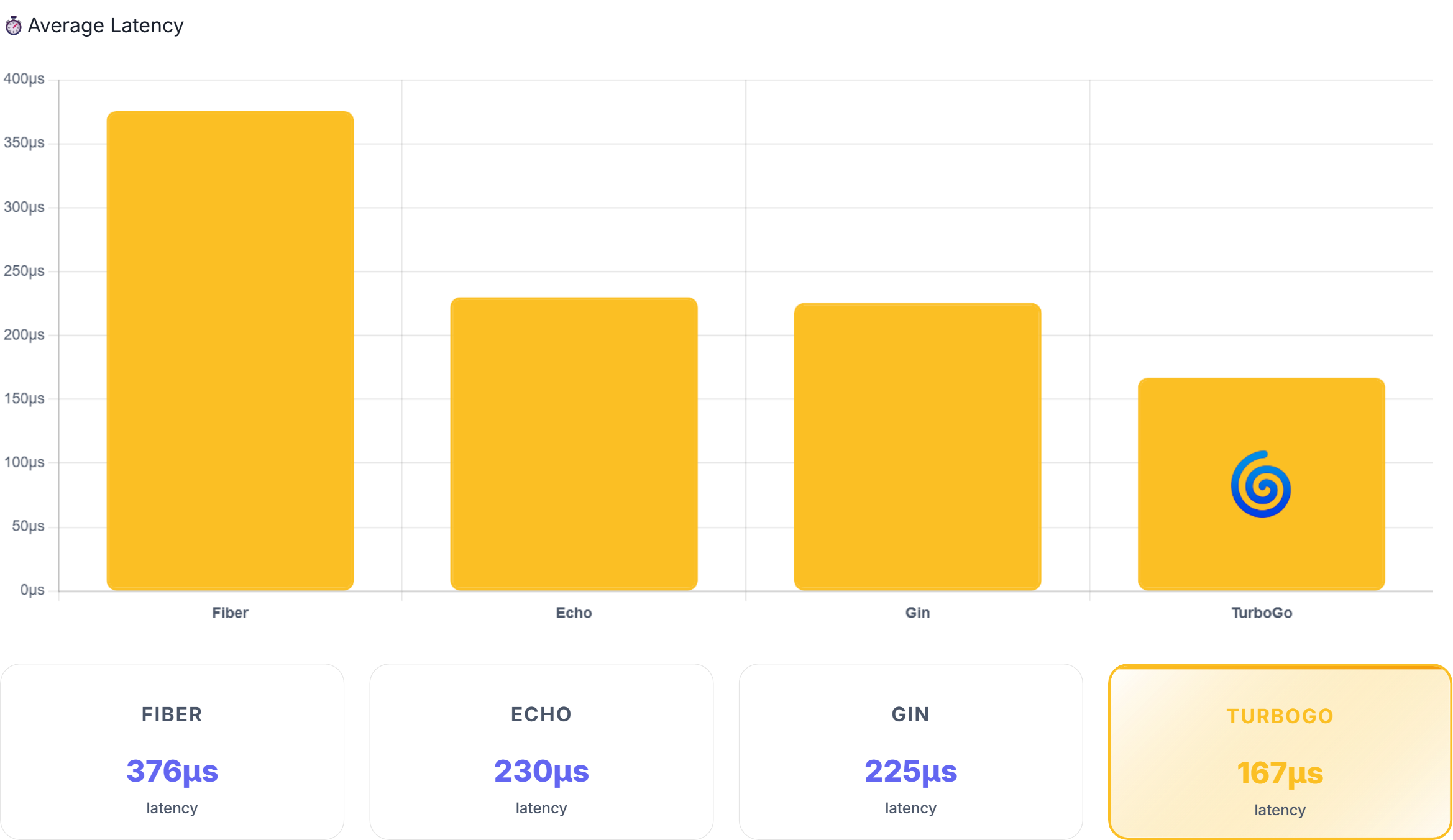
| Framework | Latency |
|---|---|
| TurboGo 🌀 | 167μs |
| Echo | 230μs |
| Gin | 225μs |
| Fiber | 376μs |
⏱️ TurboGo consistently delivers the lowest response times, making it an excellent choice for building ultra-fast and responsive APIs.
Concurrency Performance
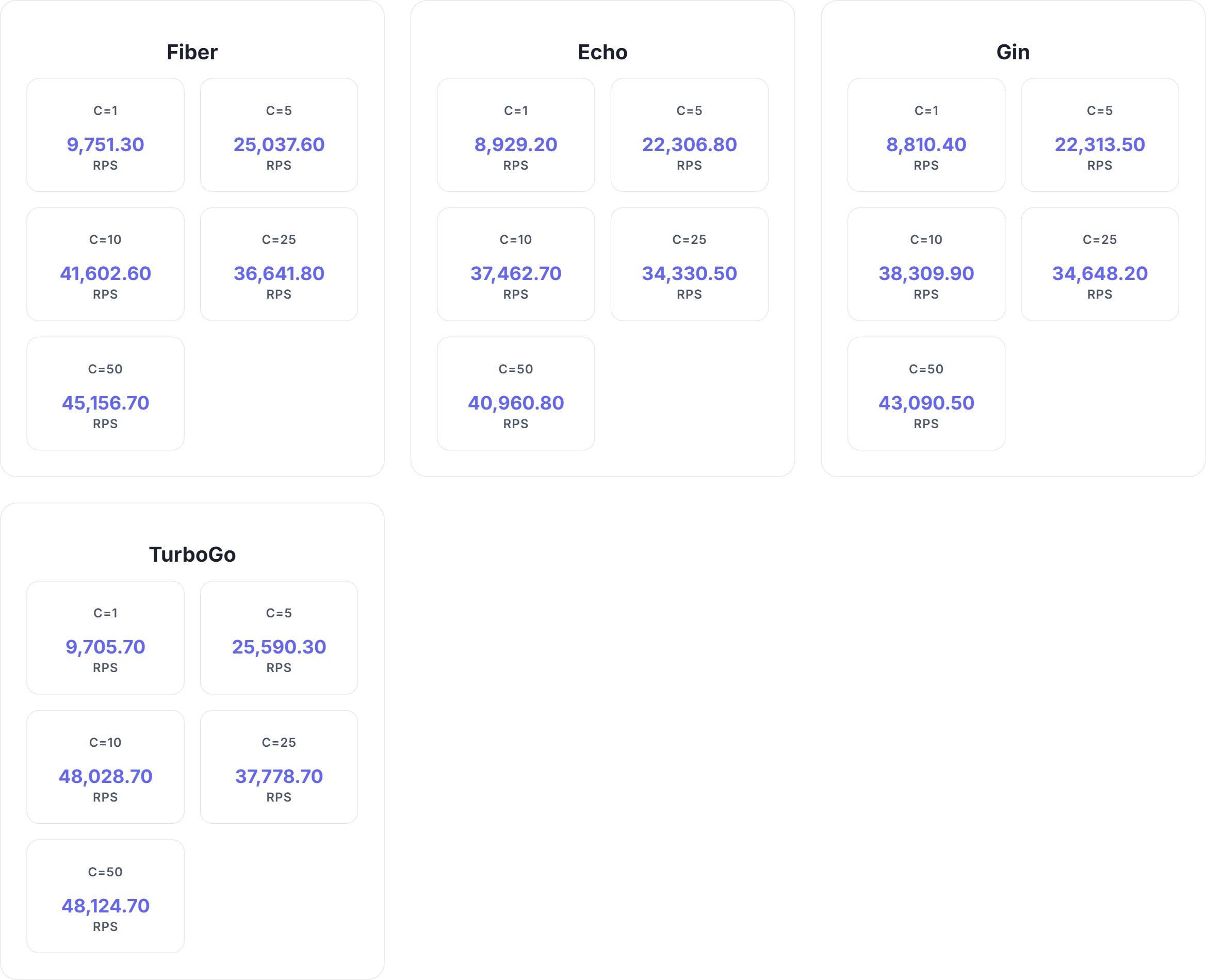
| Concurrency | TurboGo 🌀 | Fiber | Gin | Echo |
|---|---|---|---|---|
| 1 | 9,705.70 | 9,751.30 | 8,810.40 | 8,929.20 |
| 5 | 25,590.30 | 25,037.60 | 22,313.50 | 22,306.80 |
| 10 | 48,028.70 | 41,602.60 | 38,309.90 | 37,462.70 |
| 25 | 37,778.70 | 36,641.80 | 34,648.20 | 34,330.50 |
| 50 | 48,124.70 | 45,156.70 | 43,090.50 | 40,960.80 |
⚙️ TurboGo delivers high and consistent performance across all concurrency levels. It leads at 10 and 50 concurrent requests with 48k+ req/sec, proving its scalability.
Requests Per Second (RPS)
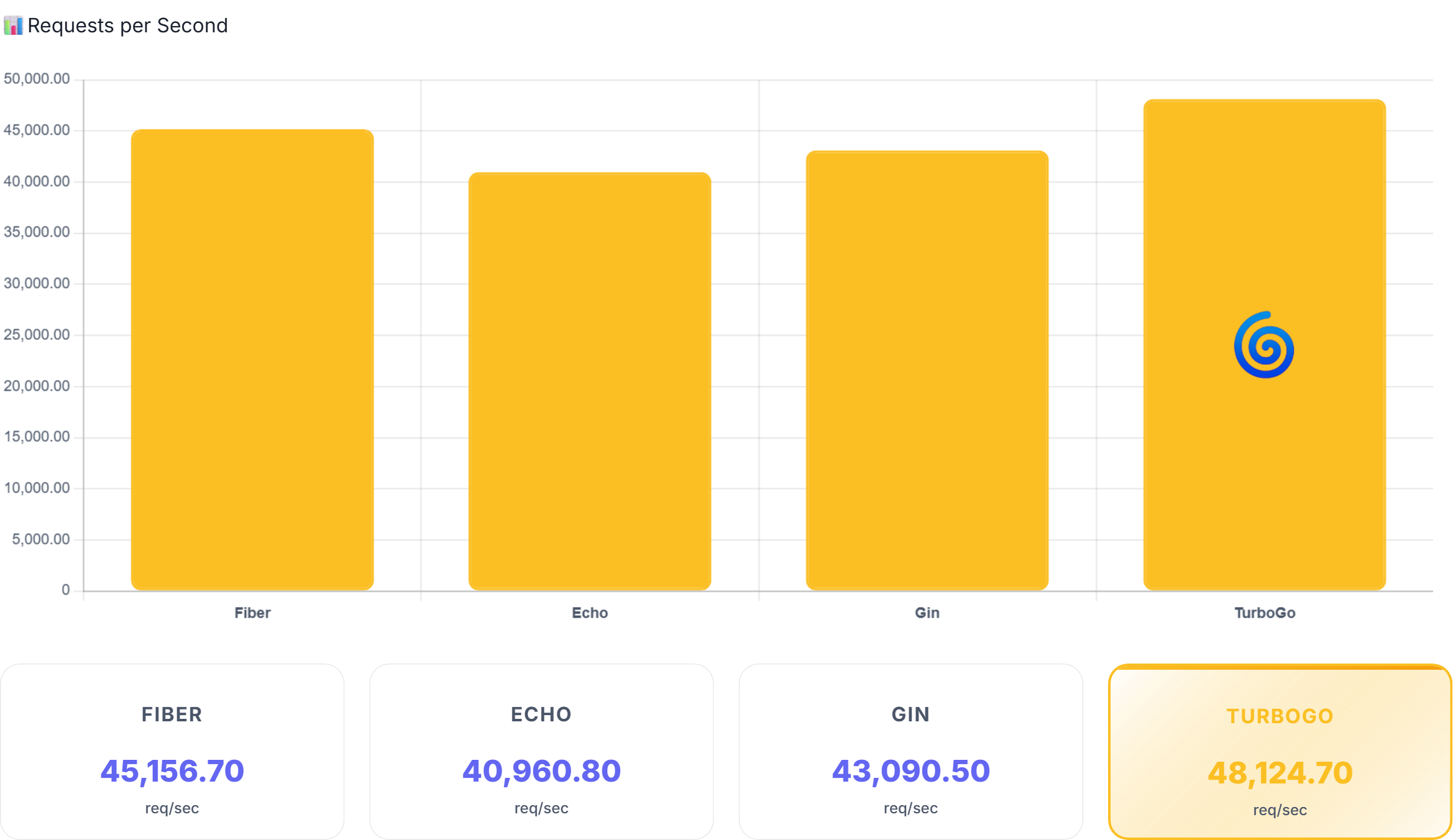
| Framework | Requests/sec |
|---|---|
| TurboGo 🌀 | 48,124.70 |
| Echo | 40,960.80 |
| Gin | 43,090.50 |
| Fiber | 45,156.70 |
📊 TurboGo handles high traffic efficiently, maintaining stability and outperforming other frameworks in throughput.
Built-in Features
TurboGo ships with powerful built-in systems to accelerate backend development:
- ✅ Routing Engine – middleware-first with handler chaining
- ✅ Custom Context – fast and lightweight with DI support
- ✅ Persistent Queue – task queue system with memory & file support
- ✅ Pub/Sub System – event-based communication out of the box
- ✅ Caching Layer – in-memory and file-based cache with TTL
- ✅ CLI Generator – project scaffolding via
turbogo new - ✅ Structured Logger – no external dependency required
Stay Connected
Follow development or contribute on GitHub. Be a part of TurboGo’s journey to becoming a next-gen Go backend framework.